

In every industrial facility, whether manufacturing lines, water treatment, or heavy-duty pumping stations, one unwelcome guest looms large: unplanned downtime. A motor stalls. A pump bearings seize. A hoist fails. Suddenly, the production schedule derails, safety is compromised, compliance headaches escalate, and costs spiral, sometimes into the tens of thousands in lost revenue, emergency labor, and replacement parts.
For plant managers, maintenance engineers, EHS officers, and procurement leads in St. Louis, MO, the question isn’t just “How do we react when something breaks?” but “How do we stop breakdowns from happening in the first place?” That’s the promise of predictive maintenance services. When done right, it’s not maintenance, it’s foresight.
This guide outlines what predictive maintenance means for St. Louis area industrial operations, how it works, when it matters most, and how to implement it to maximize uptime, safety, and return on maintenance spend.
Why Predictive Maintenance Matters for St. Louis Industry
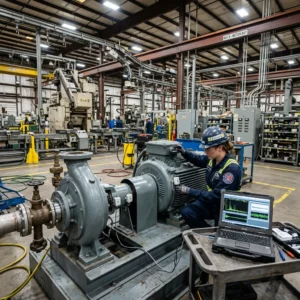
Why Predictive Maintenance Matters
In the context of a St. Louis-based facility relying on rotating equipment, electric motors, pumps, conveyors, or hoists, the most critical business outcome tied to predictive maintenance is maximizing uptime and preventing catastrophic failures.
Such facilities often run 24/7 or follow tight production schedules. A single motor-pump assembly or crane/hoist failure can cause hours or days of downtime, disrupt supply lines, and trigger costly emergency repairs or compliance delays. Implementing predictive maintenance services helps transform uncertain operations into predictable, stable workflows, ensuring that downtime becomes planned, not disruptive.
For a typical plant in St. Louis, the ability to reduce unplanned downtime by a significant margin (often 70% to 85%) can translate directly into tens of thousands of dollars saved per month, safer operations, and longer asset life.
Implementation of Predictive Maintenance Services in St. Louis
Given the intent (informational + how to / practical guidance), here’s a step by step Implementation Playbook for facility managers considering predictive maintenance services with Zeller Technologies.
Step-by-Step Procedure
- Define Critical Asset Inventory: List all motors, pumps, hoists, drives, and rotating equipment that are mission-critical to production or safety.
- Baseline Data Collection: For each asset, run initial diagnostics: vibration spectrum, thermal scan, motor-circuit test, motion amplification baseline capture. Store data in a log (spreadsheet, CMMS, or shared database).
- Set Monitoring Frequency & Thresholds: Determine inspection intervals (monthly vibration scans, quarterly thermal scans, annual motor-circuit tests) and establish alarm thresholds when readings deviate beyond baseline norms.
- Assign Roles & Responsibilities: Maintenance Tech: perform vibration & thermography; Reliability Engineer: review trends; EHS: verify safety compliance; Procurement: flag replacement parts when alerts trigger.
- Create Maintenance Response Workflow: When a diagnostic fails or crosses threshold: generate work order, schedule maintenance, order parts, perform repair/realignment/replacement, then re-baseline after completion.
- Document & Report Findings: Archive all diagnostics, actions taken, parts replaced, and operational outcomes (downtime avoided, cost saved). Use this for monthly/quarterly reviews.
- Continuous Improvement and Trending: Review historical data quarterly to detect patterns, recurring failure modes, and opportunities to optimize maintenance strategies.
- Integrate with Broader Maintenance Strategy: Combine predictive maintenance with preventive and reactive maintenance as part of a full maintenance management approach (CMMS).
- Engage with a Trusted Partner: Reach out to Zeller Technologies to perform advanced diagnostics and periodic assessments.
Risk Controls & Safety Considerations

When running predictive maintenance inspections on site, especially for motors, pumps, cranes/hoists, and drive systems, safety and risk controls are critical. Key controls:
- Ensure lockout/tagout (LOTO) before any sensor installation or inspection.
- Use proper PPE when performing thermography or working near energized panels.
- For vibration sensors on rotating machinery: install while the machine is at rest unless the procedure allows safe operation.
- Secure all couplings, guards, and housings before restarting equipment after inspection/repair.
- For cranes/hoists: ensure load is removed or secured before any diagnostics or alignment procedures.
- Maintain clear documentation of inspections, findings, and corrective actions for EHS compliance and audit readiness.
When to Take Immediate Maintenance Action
Consider immediate action when:
- Vibration amplitude exceeds baseline by 20% or shows abnormal frequency peaks → schedule mechanical inspection and coupling/alignment check.
- Thermal scan shows hot spots > 10 to 15 °F above normal under load → inspect electrical connections, insulation, and bearings.
- Motion amplification detects structural deflection or abnormal movement → check machine mountings, base bolts, alignment.
- Motor circuit diagnostics report abnormal current draw, insulation drop, or winding anomalies → plan electrical inspection or rewind/replace motor.
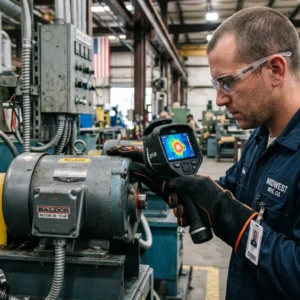
If any of these triggers occur, contact Zeller Technologies to schedule a full PdM diagnostic scan and corrective maintenance.
Frequently Asked Questions (FAQS)
1. What makes predictive maintenance different from preventive maintenance?
Predictive maintenance (PdM) uses real time or periodic condition monitoring (vibration, temperature, electrical data) to decide when maintenance is needed, not just on a fixed schedule. Preventive maintenance, by contrast, follows calendar or runtime based intervals regardless of actual equipment condition.
2. What kind of equipment benefits most from predictive maintenance in a St. Louis plant?
Rotating equipment (motors, pumps, fans, compressors), hoists/cranes, drive systems, and any critical electrical mechanical systems, especially those whose failure would cause major downtime or safety risk.
3. How often should diagnostics like vibration analysis or infrared surveys be conducted?
It depends on equipment criticality and usage, but many plants begin with quarterly or monthly vibration scans and annual thermal/ motor circuit checks, with adjustments based on operating hours, load, and historical data trends.
4. Is predictive maintenance expensive to implement?
Initial diagnostics and setup involve some cost (specialized sensors, technician time), but compared with the cost of emergency repairs, extended downtime, or full motor/pump replacement, PdM typically pays for itself quickly, often with ROI in months.
5. Can predictive maintenance also improve safety and compliance?
Yes. By detecting electrical faults, bearing overheating, or structural stresses early, PdM helps prevent fires, mechanical failures, and unplanned shutdowns, reducing safety hazards and ensuring reliable compliance with operational standards.
Ready to Strengthen Your Facility’s Reliability?
For any industrial facility in St. Louis, whether running motors, pumps, hoists, drives, or complex mechanical systems, predictive maintenance is not just a nice-to-have: it’s a strategic necessity. By transforming reactive maintenance into foresight, you safeguard uptime, protect assets, reduce costs, and strengthen safety and compliance.
Ready to see what hidden risks lurk in your motors, pumps, or hoists? Contact Zeller Technologies to schedule a full predictive maintenance assessment, including vibration analysis, infrared diagnostics, and structural monitoring. Let’s turn what could be a surprise failure into a routine, planned maintenance success.