

In manufacturing environments across St. Louis, electric motors power conveyors, pumps, compressors, mixers, crushers, and fans. When one fails, the impact goes far beyond the maintenance department. Production halts. Safety exposure increases. Emergency labor costs rise. Compliance documentation becomes urgent.
For plant managers, reliability engineers, EHS leaders, and procurement teams, choosing the right industrial motor repair St Louis, MO, provider is a strategic risk decision. The wrong choice can mean recurring failures, warranty disputes, and lost production. The right partner restores reliability and protects uptime.
This guide explains what to evaluate, what proof to demand, and how to make a defensible, data-backed selection.
Industrial Motor Repair St Louis, MO in High-Duty Environments
In the St. Louis region, industrial motors commonly operate in:
- High-humidity or washdown food processing plants
- Dust-heavy grain, aggregate, and material handling facilities
- Chemical and municipal utility environments
- VFD-controlled continuous-duty applications
The primary business objective:
Restore motor reliability while reducing repeat failures and minimizing downtime cost exposure.
In facilities where downtime can exceed $10,000 per hour, selecting an industrial motor repair company is a reliability strategy, not a commodity purchase.
Common Industrial Motor Failure Indicators
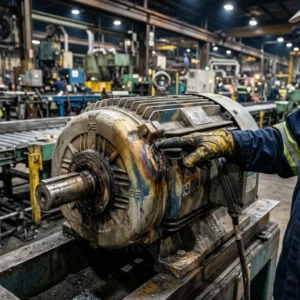
Most teams begin searching for industrial motor repair in St. Louis, MO when one of these symptoms appears:
1. Repeated Bearing Failures
Likely causes: misalignment, imbalance, and electrical fluting from VFDs.
Immediate step: Perform vibration analysis before removal.
2. Overheating Under Normal Load
Likely causes: improper rewinding, voltage imbalance >1%, blocked cooling passages.
Immediate step: Conduct infrared thermography under load.
3. Nuisance Breaker Trips
Likely causes: insulation breakdown or shorted windings.
Immediate step: Perform insulation resistance and polarization index testing per IEEE 43.
4. Increased Vibration After Reinstallation
Likely causes: poor balancing or improper installation.
Immediate step: Verify ISO 1940 balance grade and laser alignment tolerances.
If a repair company cannot clearly explain the root cause and show measured data, the failure may repeat.
Testing Protocols You Should Expect
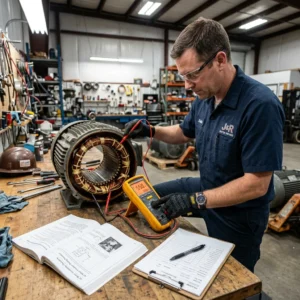
When selecting an industrial motor repair company in St Louis, MO, require documented testing.
Insulation Resistance & Polarization Index
- Measure phase-to-ground and phase-to-phase
- PI ratio ≥ 2.0 is typically acceptable
- Temperature-corrected megohm values required
Surge Testing
- Detects turn-to-turn faults
- Balanced waveforms across phases indicate integrity
Vibration Analysis
- Overall velocity target: typically < 0.15 in/s RMS for general industrial equipment
- Confirms balance and alignment quality
Dynamic Balancing
- Conform to ISO 1940 G2.5 or better for most industrial applications
A reputable provider supplies written test reports as part of job closeout documentation.
Safety Controls for Industrial Motor Repair in St Louis, MO
- Lockout/Tagout per OSHA 1910.147
- Arc flash labeling compliance per NFPA 70E
- Proper rigging for large-frame motors
- VFD discharge verification before servicing
- Controlled bearing heating during installation
Safety compliance should be integrated into the repair provider’s documented workflow.
Industrial Motor Repair Case Study
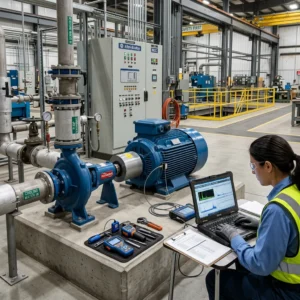
At a St. Louis manufacturing plant, a 100 HP pump motor experienced two failures within a single year, disrupting production and increasing maintenance costs. Initial inspections relied on basic testing methods, which failed to detect insulation degradation caused by VFD-induced voltage stress.
A more detailed evaluation, including surge comparison testing, revealed turn-to-turn weakness within the windings. The repair strategy included upgrading the insulation system to better withstand high-frequency voltage spikes. Following the corrective action, the mean time between failures (MTBF) increased from 10 months to more than four years, and overall vibration levels dropped by 30 percent.
Frequently Asked Questions (FAQs)
1. How long does industrial motor repair take in St Louis, MO?
Most industrial motor repair in St Louis, MO, facilities complete standard repairs within 24 to 72 hours, depending on motor size, voltage class, and damage severity. Larger frame motors or extensive rewinds may require additional time for coil fabrication and curing. Shops with in-house surge testing, dynamic balancing, and machining capabilities often reduce delays. Emergency industrial motor repair services can expedite turnaround when downtime costs are high. Always confirm whether testing, documentation, and load verification are included in the stated timeline.
2. Is motor rewinding reliable for long-term use?
Motor rewinding can be highly reliable when performed according to IEEE and NEMA MG-1 standards. The key factor is whether the repair provider conducts proper core testing, surge comparison testing, and insulation resistance validation. High-quality materials and controlled winding processes preserve efficiency and thermal performance. When root cause analysis addresses the original failure mechanism, rewound motors often achieve comparable service life to new units. Long-term reliability ultimately depends on installation quality, alignment, and operating conditions.
3. What certifications should a motor repair company have?
A qualified industrial motor repair company in St Louis, MO, should follow IEEE testing standards and NEMA guidelines. Technicians should be trained in vibration analysis, insulation diagnostics, and ISO 1940 dynamic balancing procedures. Compliance with OSHA lockout/tagout requirements and NFPA 70E arc flash safety standards is essential. Look for documented quality control processes and written repair reports as part of closeout documentation. Evidence of a structured root cause failure analysis capability is also a strong indicator of technical maturity.
4. When should I replace instead of repair?
Replacement should be evaluated when a motor experiences repeated failures within 12 months. If efficiency degradation exceeds 3–5%, upgrading to a premium-efficiency motor may reduce long-term energy costs. Obsolete components or unavailable parts can also make repair economically impractical. A repair-versus-replace decision should factor in downtime cost per hour and expected MTBF improvement. Conducting a formal ROI comparison ensures the decision supports both reliability and financial objectives.
5. How can I prevent repeat industrial motor failures?
Preventing repeat failures starts with identifying the true root cause rather than simply replacing damaged components. Implement predictive maintenance practices such as vibration analysis, infrared thermography, and periodic insulation resistance testing. Ensure proper laser alignment and balance verification during installation to reduce mechanical stress. Review VFD settings and harmonic conditions to protect winding insulation and bearings. Establishing a documented preventive maintenance schedule significantly extends motor life and improves overall equipment reliability.
Need Fast Industrial Motor Repair in St Louis, MO?
When evaluating an industrial motor repair St Louis, MO provider, make your decision based on documented performance, not just price. A qualified industrial motor repair company should deliver a detailed motor failure analysis, insulation resistance and polarization index results per IEEE 43, surge testing data, vibration reports, and ISO 1940 balance verification.
Before reinstalling any critical electric motor, establish clear acceptance criteria and confirm alignment with NEMA and OSHA safety standards. Choosing a data-driven industrial motor repair service in St Louis, MO, protects uptime, reduces repeat failures, and ensures long-term equipment reliability.