
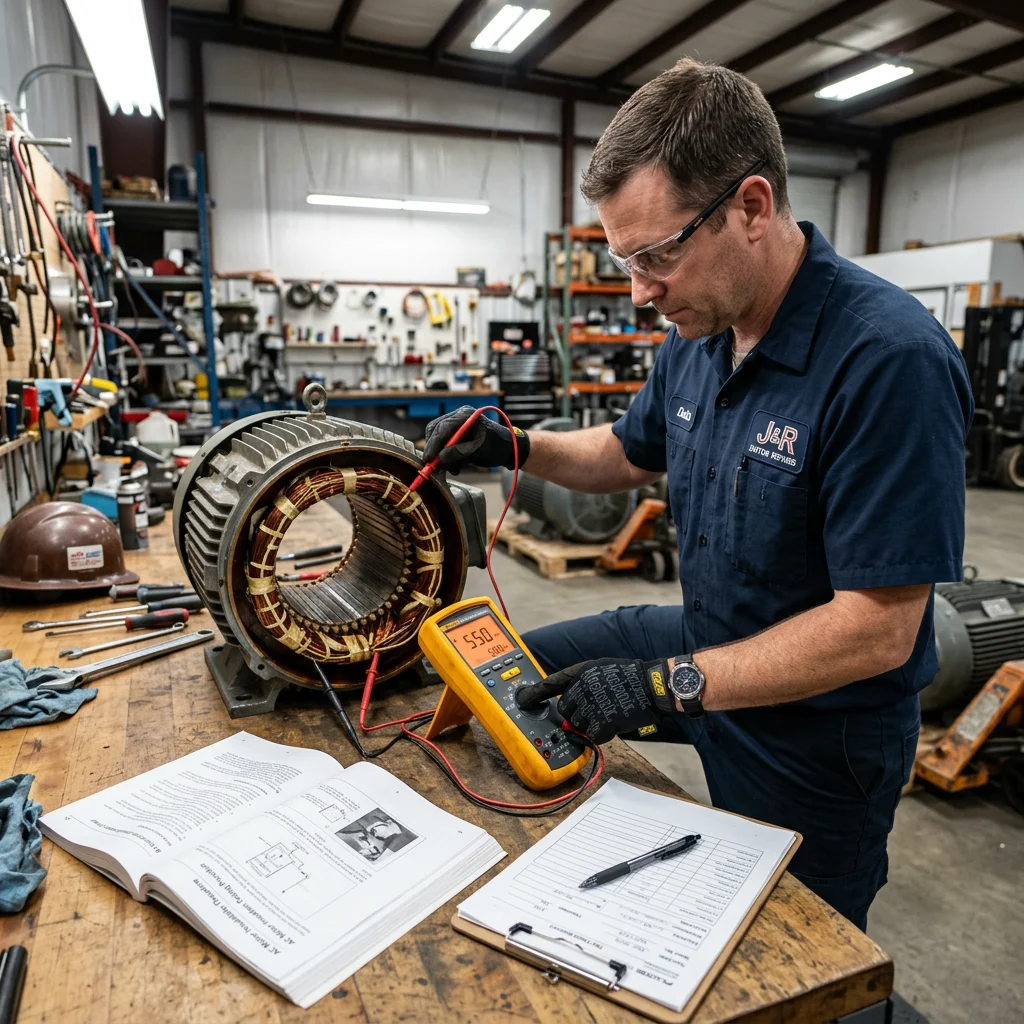
In a busy industrial plant where pumps, conveyors, fans, and compressors hum day and night, the heartbeat of operations often lies in the electric motors behind them. When a motor fails unexpectedly, the result is more than silence: it’s halted production, emergency overtime, safety hazards, and unplanned repair costs.
For plant managers, maintenance engineers, safety (EHS) leads, and procurement officers, the stakes are real. You need motors to run reliably, safely, and efficiently. That’s why a transparent, expert-driven electric motor repair process, especially in a hub like St. Louis, MO, matters. It’s not just about fixing a motor. It’s about restoring uptime, ensuring safety and compliance, and protecting your bottom line.
In this article, we walk you through exactly how a trusted shop like Zeller Technologies tackles electric motor repair step by step so you know what to expect, where value lies, and when to act.
Most industrial facilities in and around St. Louis, MO, rely on AC (and sometimes DC) motors in heavy duty applications: large pumps, compressors, conveyors, fans, or material-handling cranes and hoists. These motors often run continuously, 24/7, under high loads.
In this scenario, the most critical business outcome is minimizing unplanned downtime, ideally reducing motor related downtime hours by 50 to 70% after repair and preventive maintenance. That translates directly into improved throughput, lower emergency costs, and better compliance with production schedules.
The Electric Motor Repair Workflow
Below is the typical step by step procedure followed by a trusted repair center like Zeller Technologies when executing an electric motor repair in St. Louis, MO.
Electric Motor Repair Process Step by Step
- Initial Triage & Submission
- Plant maintenance identifies symptoms (vibration, overheating, trip, inefficiency).
- Submit the motor to the repair shop (on site or shop repair). Zeller allows 24/7 emergency requests.
- Disassembly & Visual Inspection
- Disassemble motor per safety protocols; inspect stator & rotor, bearings, shaft, and mountings.
- Document mechanical wear, bearing condition, rotor bar damage, insulation discoloration, or contamination.
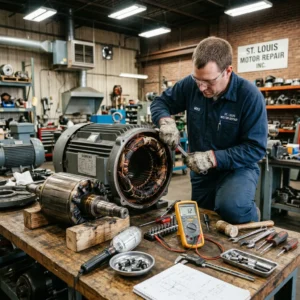
- Diagnostic Testing (Electrical & Mechanical)
- Perform insulation resistance test, surge or Hi-Pot test if necessary.
- Conduct vibration analysis, bearing checks, and alignment evaluation.
- Use the current draw test under idle or known load if applicable.
- Analysis & Report Generation
- Translate findings into a repair/rewind recommendation (or reject if beyond economical repair).
- Provide a detailed estimate and expected lead time.
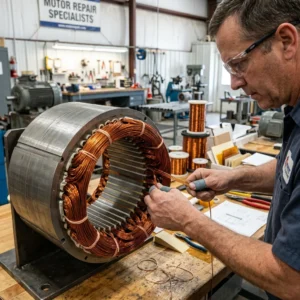
- Repair / Rewind / Bearing or Rotor Work
- If windings are compromised → rewind to industry standard (EASA spec).
- Replace bearings, shaft parts, or other damaged mechanical components.
- If rotor bars are cracked or a rotor eccentricity is present → repair or replace the rotor as needed.
- Reassembly & Dynamic Balancing
- Reassemble motor; perform dynamic balancing to ensure smooth rotation under load.
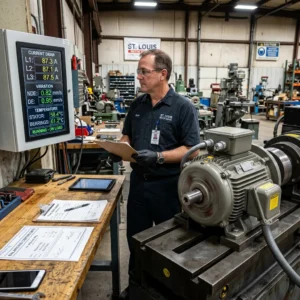
- Load Testing & Quality Assurance
- Run motor under load conditions (as close to actual service conditions as possible).
- Monitor vibration, current draw, temperature, and load performance. Document results.
- Certification & Return to Service
- Final inspection, certificate of repair (if required), and re-installation guidance.
- Update maintenance logs and schedule the next PdM check or predictive maintenance cycle.
This workflow mirrors exactly what a professional, factory-authorized service provider like “Zeller Technologies Motor Services” follows.
Ensuring Compliance and Safety in Electric Motor Rewinds and Repairs
While the primary goal is reliability and uptime, compliance and safety matter just as much. During electric motor repair:
- Repairs and rewinds should meet recognized industry standards (EASA rewind practices). A rewind done to spec ensures insulation integrity and reduces the risk of failure.
- Post-repair testing (insulation resistance, load test, balancing) provides documented proof, which may be required for compliance audits, especially in regulated industries or for safety critical equipment.
- For hoists, cranes, or motors connected to lifting/handling equipment, on-site inspections must consider lockout tagout (LOTO) procedures, arc flash risk, and proper reinstallation per original OEM or control-panel specs. Zeller’s broader services in cranes, hoists, and controls often address these needs.
Skipping these steps may not only jeopardize reliability but also expose the plant to safety and compliance liabilities.
Risk Controls & Safety
When undertaking electric motor repair, especially in an industrial plant:
- Enforce LOTO (lockout tagout) before disassembly or removal to prevent accidental energization.
- Use PPE (gloves, eye protection, insulated tools) when handling windings, rotating shafts, or heavy parts.
- For heavy motors or hoist mounted equipment: follow safe rigging, lifting, and crane procedures during removal/installation.
- Confirm motor grounding and proper re-bonding after reassembly; test insulation before energizing.
- Ensure post-repair balancing and current testing before returning to operation to avoid vibration or electrical overload hazards.
Frequently Asked Questions (FAQS)
1. What types of electric motors can be repaired by a professional shop in St. Louis?
A qualified industrial repair center can service AC induction motors, DC motors, medium-voltage units, and specialized designs such as explosion-proof or washdown duty equipment. These shops handle everything from fractional horsepower units to large frame, process critical machines used in pumps, conveyors, cranes, and compressors. This ensures a single partner can support both everyday production motors and mission-critical assets across your facility.
2. How long does an electric motor repair typically take in St. Louis, MO?
Most mechanical repairs or bearing replacements take 3 to 5 days, while a full rewind usually requires 5 to 7 days, depending on motor size and condition. Emergency repairs, however, can often be completed within 24 hours to minimize downtime in high impact environments. A structured workflow ensures diagnostics, repair, balancing, and testing are completed with predictable lead times.
3. How do I know whether my motor needs repair, rewind, or full replacement?
The right choice depends on diagnostics: repair is suitable for mechanical wear, rewind is recommended when insulation or windings fail, and replacement is best when repair costs exceed 60 to 70% of new equipment. A proper test report will show insulation values, vibration levels, and load performance to guide the decision. Most plants choose the path that delivers the lowest lifecycle cost while maintaining reliability.
4. What diagnostics should be performed before determining the repair scope?
Essential tests include vibration analysis, insulation resistance testing, surge testing, current signature analysis, and thermal imaging. These diagnostics pinpoint whether the issue is electrical, mechanical, or load related, so the repair scope is accurate and cost justified. Using data backed results helps reduce repeat failures and supports predictive maintenance planning.
5. What warranty or documentation should I expect after a professional electric motor repair?
A reputable shop provides warranty coverage plus detailed pre and post repair test reports that include insulation readings, vibration levels, and load test results. Documentation often includes balancing certificates, material certifications, and proof that the motor meets performance specifications. These records help support reliability programs, EHS compliance, and future maintenance planning.
6. How much does an electric motor repair cost in St. Louis, MO?
Costs range widely, from a few hundred dollars for minor repairs to several thousand for full rewinds, especially on medium voltage or large-frame motors. Emergency service may add a premium, but the cost is often justified when downtime is extremely expensive. Ultimately, calculating downtime savings versus repair cost provides the most accurate ROI picture.
7. Can electric motors be tested or evaluated without removing them from the plant floor?
Yes, many diagnostics, such as vibration analysis, power monitoring, and infrared scanning, can be performed while the motor is still running. These online tests help detect early stage problems and reduce unnecessary removals or shutdowns. Only deeper electrical tests, such as surge or hipot, require the motor to be taken offline.
8. How often should electric motors undergo preventive diagnostics?
Critical motors typically need diagnostics every six months, while standard production assets are often evaluated annually. Plants operating in harsh or high duty environments may perform testing every three to six months to stay ahead of failure trends. Following a structured predictive maintenance schedule can cut motor-related downtime by 30 to 50%.
Don’t Let a Motor Failure Disrupt Production, Schedule a Full Diagnostic & Repair
Electric motor failure doesn’t have to mean chaos. With the right partner and a structured repair process, you can turn breakdowns into planned maintenance, preserve uptime, and protect your bottom line.
If you operate industrial motors in or around St. Louis and want to eliminate unexpected downtime, consider submitting your motor for a full diagnostic & repair at Zeller Technologies.
Next Steps:
- Request a comprehensive motor failure analysis
- Book an infrared or vibration scan for predictive maintenance