
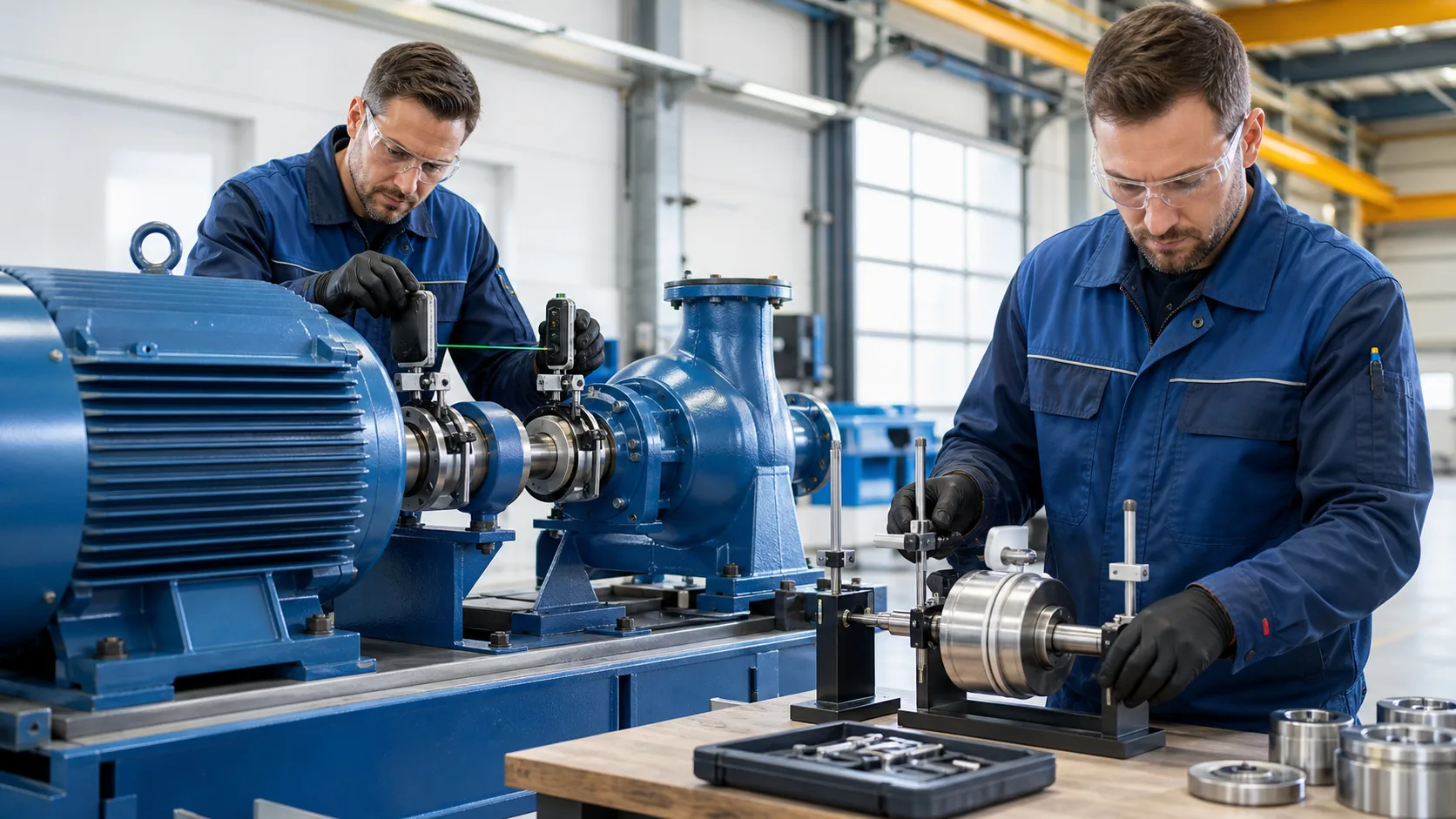
Rotor Vibration Decisions That Protect Uptime
Rotor vibration is not a single-fault problem. Before we recommend corrective work, we distinguish between rotor imbalance, shaft misalignment, and other mechanical conditions that can create similar symptoms. That distinction protects equipment reliability, production capacity, and worker safety.
Persistent vibration can accelerate bearing wear, damage seals, deteriorate couplings, raise operating energy demands, and lead to unplanned downtime. Dynamic balancing and shaft alignment are complementary precision-maintenance practices, but they use different measurements and correct different problems. As late fall brings tighter year-end schedules, seasonal staffing constraints, and possible weather disruptions, known vibration concerns deserve attention before planned maintenance windows become harder to secure.
Identify the Root Cause Before Selecting a Repair Method
Dynamic imbalance occurs when mass is not distributed evenly around a rotating assembly’s centerline. As the rotor turns, that uneven mass creates centrifugal force. Higher running speeds can make the force and resulting vibration more severe.
Shaft misalignment is different. It describes an incorrect positional relationship between connected machine shafts, often between an electric motor and a pump, gearbox, fan, blower, or hoist drive. We evaluate several forms of misalignment:
- Angular misalignment, where shaft centerlines meet at an angle
- Parallel misalignment, where shafts are offset from one another
- Combination misalignment, where angle and offset occur together
Both conditions can produce elevated vibration, heat, bearing distress, and coupling wear. That overlap can lead to an incorrect repair if maintenance decisions are based only on what is visible or audible. Dynamic balancing in St. Louis should begin with diagnostic testing, not the assumption that every vibration issue comes from an unbalanced rotor.
Recognize Vibration Patterns That Point to Imbalance
Certain vibration patterns can point toward imbalance. We often look for vibration at one times running speed, along with amplitude that rises as equipment speed increases. Imbalance-related vibration may also remain fairly consistent even when coupling condition changes, although a complete diagnosis must account for the full machine condition.
Rotating components that may be affected include electric motor rotors, pump rotors, fans, blowers, armatures, sheaves, and crane or hoist drive components. The cause is not always a manufacturing issue. A rotor can become unbalanced during normal operation or after prior repair work.
Common contributors include:
- Contamination buildup on fan blades, rotors, or sheaves
- Material loss, corrosion, or damaged fan blades
- Uneven winding repairs or changes to rotor components
- Previous modifications that alter weight distribution
- Wear or damage affecting the rotating assembly
Field vibration analysis can identify whether imbalance is likely. When the rotor itself needs correction outside the assembled machine, shop-based balancing may be the appropriate next step. This process focuses on correcting the mass distribution of the rotating component, not simply reducing the vibration reading at one location.
Understand When Shaft Alignment Is the Correct Fix
Shaft alignment focuses on the relationship between connected shafts. In motor-driven equipment, the motor and driven machine must operate in the intended position relative to one another. Even a well-balanced rotor can create damaging system forces when the shafts are not aligned correctly.
Misalignment can develop for several reasons. Improper installation, base distortion, loose fasteners, settling foundations, pipe strain, and changes after a motor replacement can all affect shaft position. Thermal growth also matters because equipment may shift as operating temperatures change.
Poor alignment can create excessive axial and radial bearing loads, coupling failure, shaft fatigue, higher vibration, and reduced equipment life. For that reason, our alignment work considers more than a single initial reading. Precision laser alignment, soft-foot correction, thermal-growth compensation, and verification measurements after final bolt tightening help confirm that the machine remains positioned correctly under expected operating conditions.
Alignment is not a one-time assumption after installation. If a machine has repeated coupling damage, recurring bearing problems, or vibration that changes after service work, we recommend reassessing the entire drivetrain relationship.
Combine Diagnostics with Dynamic Balancing in St. Louis
The strongest repair decisions follow a disciplined diagnostic sequence. Rather than treating vibration as a stand-alone number, we evaluate the connected equipment and operating history as a system.
Our process may include:
- Reviewing operating history and reported equipment changes
- Collecting vibration data and inspecting mechanical conditions
- Verifying alignment and checking for soft foot or loose components
- Assessing rotor condition and determining whether balancing is needed
- Confirming the repair with post-service testing
Balancing without correcting misalignment can leave harmful forces in the system. Likewise, precise alignment cannot correct a rotor with uneven mass distribution. In some cases, both services are needed. In others, the diagnostic results may point to a different mechanical condition that must be addressed first.
For regional industrial facilities, dynamic balancing in St. Louis can involve field diagnostics, shop balancing, emergency repairs, and planned maintenance support. Our technicians evaluate electric motors, rotating assemblies, industrial controls, crane systems, and connected drivetrain components together, because a vibration issue can travel through more than one part of the system.
Build a Winter-Ready Vibration Maintenance Plan
Before winter weather and year-end production demands narrow maintenance access, we recommend prioritizing equipment that has the greatest impact on operations. Motors, process fans, pumps, conveyors, cranes, hoists, and backup equipment should all be reviewed when they show known vibration symptoms or a history of repeated failures.
Baseline records are equally important after repairs, remanufacturing, modernization projects, or major equipment installations. A documented vibration and alignment condition gives your maintenance team a clearer point of comparison when machine behavior changes later.
Facilities should also define escalation criteria for 24/7 emergency service. Rapid vibration increases, repeated bearing failures, abnormal heat, coupling damage, and noticeable equipment performance losses should not be treated as routine operating conditions. A timely diagnostic response helps determine whether the issue involves imbalance, misalignment, or another mechanical concern before it develops into a production interruption.
Dynamic balancing and shaft alignment solve different mechanical problems, yet both belong in a complete rotor-vibration strategy. The practical goal is to identify the source of the force, apply the correct correction, and verify machine condition before minor symptoms become downtime.
Improve Rotor Reliability With Targeted Service
Zeller Technologies provides field expertise to support accurate diagnostics, correction, and verification for rotating equipment. Our team can help you schedule dynamic balancing in St. Louis when vibration data points to imbalance-related forces. For project-specific requirements or service coordination, contact us to discuss your equipment and operating conditions.