
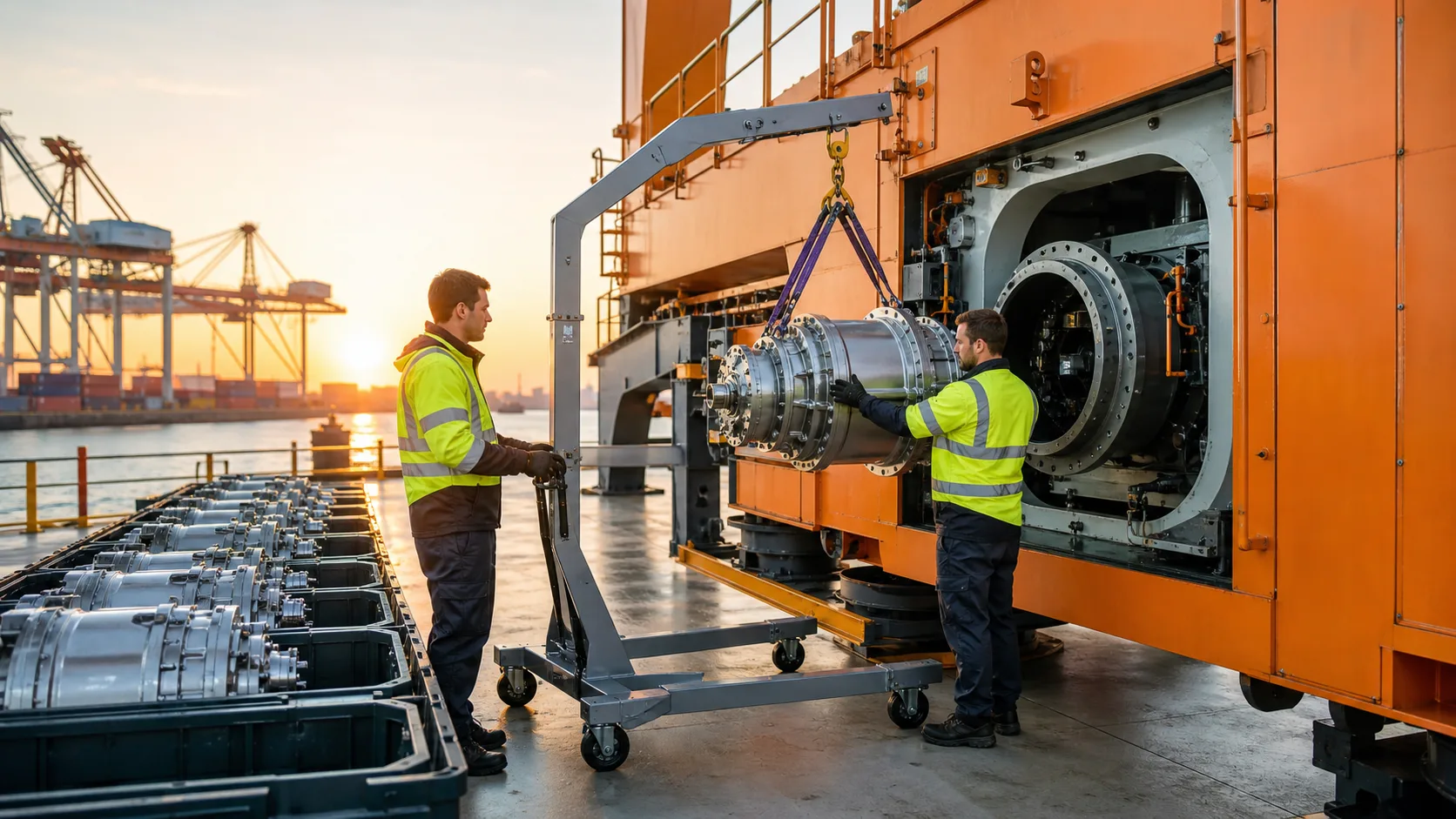
Turning Crane Gearboxes Into a Competitive Advantage
Unplanned crane outages affect far more than schedules. When a main crane is unavailable during peak production or heavy shipping, material flow is disrupted across the facility. The result is lost throughput, demurrage, overtime, expedited trucking, and increased safety exposure as personnel adopt workarounds to move product.
In many crane failures, the gearbox becomes the pacing element. Motors are typically more readily available, but gearboxes often involve long OEM lead times, non-standard ratios, and precise alignment requirements with motors and controls. Riggers and electricians may be fully prepared, yet the plant remains idle while waiting for the correct gearbox or internal gear set.
This risk is manageable rather than random. A deliberate spare gearbox strategy, clearly defined vendor SLAs, and engineered rapid-changeout plans can transform crane gearboxes from a recurring constraint into a source of competitive advantage. Zeller Technologies focuses on industrial gearbox repair, modernization, and surplus solutions that can be integrated directly into such uptime programs.
Mapping Crane Gearbox Criticality Before the Next Peak Season
The first step is to establish which crane gearboxes truly drive operational risk. Not every gearbox justifies a complete spare on the shelf. A structured criticality analysis keeps attention on the motions that will actually stop production.
Begin by Mapping Cranes Based on Role and Exposure
Start by mapping each crane according to its role and exposure. Consider the crane’s function (production feeding, furnace charging, casting, shipping, maintenance, or general service), the duty cycle it operates under (continuous, batch, or occasional), the safety impact of its loads (over people, hot metal, chemicals, or standard product), and the redundancy available (alternate cranes versus a true single point of failure).
Then drill down into individual motions and gearbox types. A failed hoist gearbox on a main production crane typically has greater operational impact than a trolley or bridge drive on a secondary unit. Slew drives on outdoor or port cranes may be more difficult to access and repair, which extends outage duration.
Apply failure mode and effects thinking by asking: which motion will stop the entire line if it is unavailable, which gearbox is most difficult to remove and reinstall, and which motion would create the highest safety exposure for personnel and product if it failed.
Robust data strengthens this analysis. Useful inputs include:
- Failure history and repair documentation
- Run hours or duty estimates for each crane motion
- Shock loads, overload events, and frequent inching or jogging
- Ambient conditions such as heat, cold, moisture, and corrosion
- Lubrication history, oil condition, and known alignment issues
From this, gearboxes can be ranked into criticality tiers. The highest tier informs decisions on dedicated spares, prebuilt assemblies, and enhanced condition monitoring, particularly in advance of heavy production periods or colder months when oil viscosity and metal behavior change.
Designing a Smart Spare Gearbox and Component Strategy
With criticality understood, the next step is to develop a stocking strategy that is both technically sound and economically realistic. The primary decision is what form of inventory to hold: complete units, subassemblies, or key internal components.
Key factors include:
- Risk: magnitude of downtime and safety exposure if a given gearbox fails
- Standardization: use of common ratios and frames across multiple cranes
- Capital constraints: available budget for inventory investment
For very high-criticality applications, a complete drop-in gearbox with motor interface, couplings, and brakes already matched is often the most effective option. For lower tiers, a set of gears, shafts, bearings, and seals may be sufficient, particularly when supported by a trusted industrial gearbox repair partner capable of building and testing a unit quickly.
Repair and modernization history provides important insight. Teams often encounter repeating failure modes such as overloaded pinions or overheated bearings, obsolete models where OEM support is limited, and reverse engineering is required, and opportunities to standardize ratios and mounting across multiple cranes.
Practical storage and handling details are also critical, especially heading into colder weather:
- Store spares indoors with controlled temperature and humidity
- Rotate shafts manually on a defined schedule and maintain appropriate layup lubrication
- Tag each spare with crane ID, motion (hoist, trolley, bridge, slew), ratio, and any special control notes
- Maintain documentation packages for each unit, including drawings, wiring diagrams, and alignment records
Hybrid stocking models can reduce capital outlay while maintaining coverage:
- Plant pool spares shared across similar cranes
- Vendor-owned consignment inventory located on site
- Pre-engineered surplus units that can be quickly reconfigured by a repair partner such as Zeller Technologies
Vendor SLAs That Protect Crane Uptime
A strong spare strategy is effective only when vendors support it with measurable performance. Service-level agreements for crane and industrial gearbox repair should define both response and technical expectations.
Meaningful SLAs typically include:
- Defined response times for site visits and remote support
- Commitments for failure analysis turnaround, enabling learning from each incident
- Repair lead times for standard and expedited work, with clearly reserved capacity
Commercial and technical terms should reflect the established criticality tiers. For example, top-tier crane motions may require 24/7 emergency coverage, priority queuing and escalation paths for production-stopping failures, access to interim bridge gearboxes to maintain crane operation while primary units are rebuilt, and defined upgrade paths such as higher service factor designs or improved lubrication schemes when repeat issues arise.
Parts support should also be explicitly addressed in the SLA:
- Guaranteed access to surplus gearboxes aligned to the critical list
- Reverse-engineered components for obsolete models
- Stocking levels and replenishment rules tied to the criticality analysis
Governance Keeps the Agreement Effective Over Time:
Governance ensures the agreement continues to reflect real operating conditions and performance expectations as equipment ages and demand shifts. Effective governance practices include:
- Quarterly performance reviews covering response time, repair time, and repeat failures
- Root-cause reports on every major failure, with agreed corrective actions
- Ongoing updates to the spare strategy based on emerging data and changing seasonal demand patterns
Engineering for Rapid Changeout and Minimal Production Loss
Even with appropriate parts and vendor support, changeout duration ultimately determines the length of the outage. Designing cranes and gearboxes for maintainability can significantly reduce this time.
Effective maintainability design includes:
- Standardized mounting patterns and baseplates across similar cranes
- Quick-disconnect couplings that minimize alignment time
- Plug-and-play motor and control connections with keyed connectors and clear labeling
- Pre-aligned drive bases so that spare gearboxes can be positioned and bolted with minimal adjustment
A rapid-changeout playbook for critical gearboxes provides further assurance:
- Defined roles for mechanics, electricians, planners, and safety personnel
- Lists of required tools, rigging, access equipment, and torque specifications
- Pre-commissioning of spares with run-in tests, oil checks, and insulation tests on motors
- Rehearsal of critical steps during scheduled maintenance windows so that teams are not executing processes for the first time during an unplanned outage
Predictive maintenance data integrates directly into this plan. Vibration, temperature, and oil analysis on hoist and travel gearboxes can reveal trends indicative of emerging failures. With this insight, maintenance teams can schedule changeouts during planned stops before peak periods, instead of reacting to sudden breakdowns during high-demand intervals.
A specialized industrial gearbox repair partner can support this approach by pre-building complete drop-in assemblies, verifying fit-up, and confirming alignment, backlash, and contact patterns before the unit reaches the crane bay. This shortens commissioning time and reduces the likelihood of rework.
Turning Plans Into Measurable Uptime Gains
To convert planning into measurable results, plant and maintenance leaders can follow a structured checklist:
- Complete a crane and gearbox criticality review
- Finalize a spare gearbox and key component bill of materials
- Align storage, tagging, and documentation standards for all spares
- Establish vendor SLAs with clear response and stocking commitments
- Document and rehearse rapid-changeout procedures for top-tier gearboxes
A focused set of KPIs enables tracking of impact over time:
- Crane-related downtime hours, with emphasis on gearbox-related events
- Mean time to repair for crane gearbox incidents
- Parts availability at the time of each event
- Seasonal performance, comparing peak shipping periods year over year
With a clear strategy, disciplined execution, and support from an experienced repair and surplus partner such as Zeller Technologies, crane gearboxes can be managed as strategic assets that support reliable, predictable material handling performance.
Protect Your Production With Fast, Reliable Gearbox Service
If you are facing unexpected downtime or warning signs of failure, our team is ready to respond with expert industrial gearbox repair to keep your operation moving. At Zeller Technologies, we diagnose issues quickly, source the right components, and get you back online with minimal disruption. Reach out today and let us review your situation, answer your questions, and outline the best next steps. You can also contact us to schedule service or request an emergency response.