
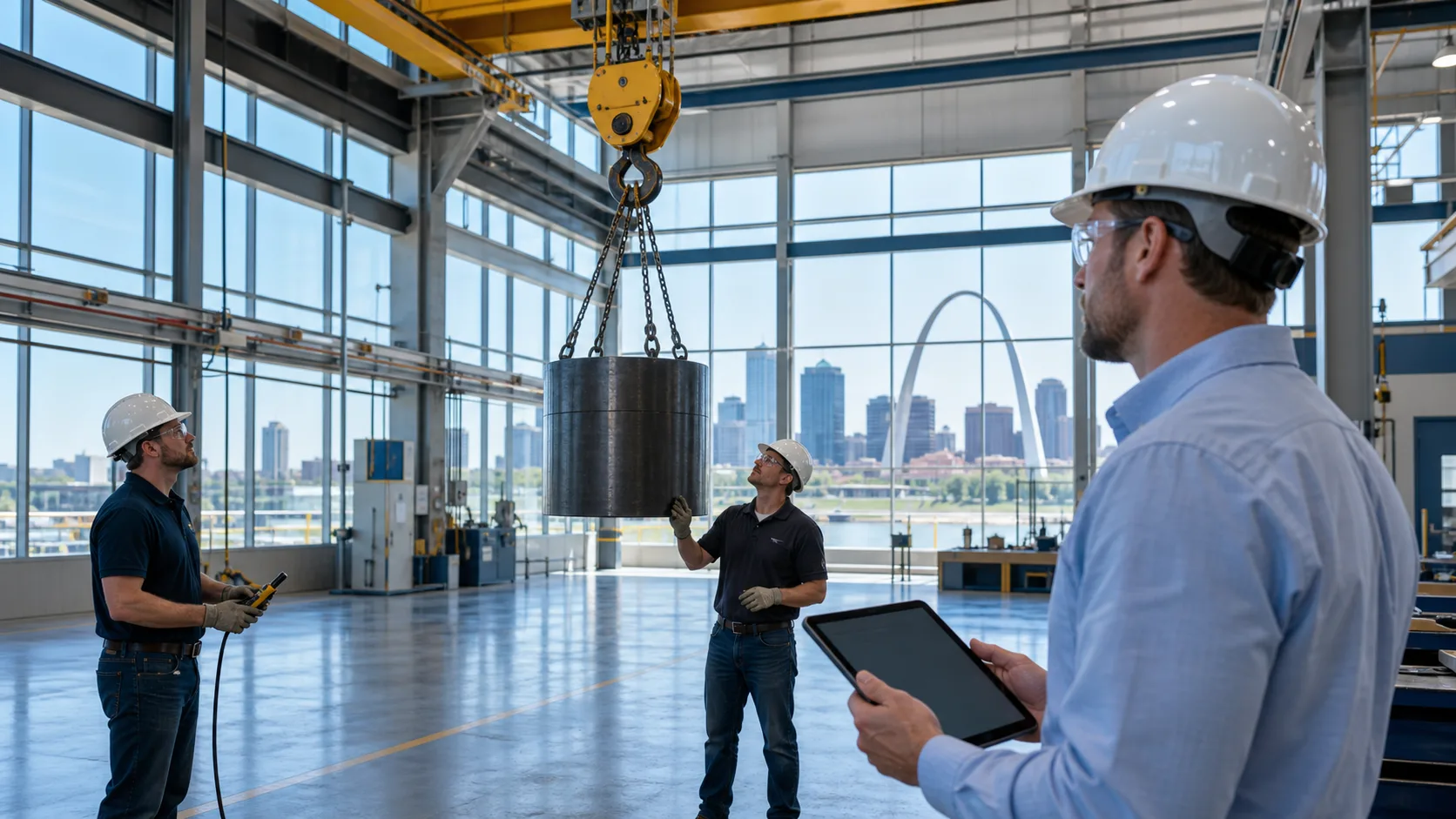
Why Load Testing Services in St. Louis Are a Strategic Priority
Load testing for cranes and hoists is not just a compliance checkbox. For heavy industry around St. Louis, it is a direct strategy to protect people, product flow, and critical assets. When a hoist is supporting steel production, power generation, or high-volume warehousing, one failed lift can ripple through the entire plant. Careful, well-planned load testing is how you prove that hoists will perform when the work is most demanding.
The St. Louis region adds its own challenges. Wide temperature swings, freezing winters, high summer humidity, and aging structures all put extra stress on steel, welds, electrical components, and controls. By late fall, many facilities want clear proof that hoists, cranes, and runways can handle winter loads and cold-start conditions. Quality load testing services in St. Louis should validate rated lifting capacity under realistic conditions, brake performance during normal stops and emergency stops, structural behavior of beams, trolleys, and runways under test load, and the response of controls, variable frequency drives, and safety interlocks when the equipment is near its limits.
Standards and Test Types That Should Guide Hoist Load Testing
Any serious load testing program for overhead cranes and hoists must be anchored in recognized standards and regulations. For industrial facilities, that usually means:
- OSHA regulations governing overhead and gantry cranes and safe lifting practices
- ASME B30 series standards that outline testing and inspection requirements
- CMAA specifications for crane service classes and design criteria
- OEM manuals that define rated capacity, allowable test percentages, and limits
Within those frameworks, it helps to separate three main types of tests. Initial proof testing is typically performed when a crane or hoist is new, newly installed, or significantly modified. Test loads often exceed rated capacity by a set percentage to prove the structure, load path, and brakes can withstand the design margin.
Periodic load testing is performed at defined intervals, or after repairs, to re-verify performance. For critical process cranes, periodic testing is often more frequent than for small maintenance hoists. The test load is usually at or slightly above rated capacity, per governing standards and OEM guidance.
Functional testing focuses on motions, controls, limit switches, and interlocks, usually at lower loads or no load. It is part of routine inspections and after maintenance tasks.
A strong, compliant test plan for a critical hoist in an industrial plant should include:
- Engineering review of rated capacity, duty class, and application
- Determination of test load percentage based on standards and OEM data
- Risk assessment that looks at load path, work area, and potential failure modes
- Integration with site safety rules, including lockout/tagout and permit requirements
- Clear criteria for pass, fail, and follow-up actions
Technical Capabilities That Separate High-Level Service Providers
Not all load testing services in St. Louis bring the same level of technical capability to the job. For advanced industrial operations, it is important to ask how they test, not just whether they test. Key capabilities include:
- Calibrated test weights, load test beams, or water bags sized for your largest cranes
- Certified load cells with current calibration records
- Data acquisition tools that record load, speed, brake torque, and deflection
- Experience with specialized hoists such as foundry, magnet, process, and automation-integrated units
Equally important is the scope of the load path under review. A meaningful test does not stop at the hoist body. It should consider all the components and structures that share the forces during a lift, including hooks, shackles, and below-the-hook devices, wire rope or chain, sheaves, and drums, gearboxes, couplings, and brakes, and the end trucks, wheels, and runway or monorail structure.
For plants with complex controls and automation, the best providers can combine load testing with controls diagnostics and fault-history review, drive parameter verification and current draw analysis, and real-time tracking of speed, acceleration, and stopping distance under load. This combined view helps expose hidden issues, such as brakes drifting out of adjustment, controls lag, or structural movement that only appears under near-capacity loads, long before winter peak demand stresses the system.
Safety, Documentation, and Regulatory Readiness
Safe execution on test day is as important as the engineering behind the plan. For industrial sites with dense production areas, contractors, and union personnel, testing must be treated like any high-risk operation. Strong practices include:
- Clearly marked exclusion zones and barriers around the test area
- Pre-job rigging verification and review of all slings and hardware
- Radio or hand-signal communication protocols agreed on before testing
- Confirmed emergency procedures, including how to handle a stuck or failed load
- Direct coordination with plant EHS and operations leadership
On the documentation side, expert buyers should expect much more than a one-line statement that a crane “passed.” A complete record typically includes:
- Calibration certificates for load cells and measuring instruments
- Detailed test reports with actual loads applied and time histories
- Graphs or logs of deflection, brake stopping distance, or drive current when applicable
- Recorded nonconformance items and recommended corrective actions
- Retention practices that support audits, OSHA inspections, and insurance reviews
When documentation is handled at this level, it becomes a strategic tool instead of a filing burden. It supports internal risk assessments, capital planning, and outage scopes, which is especially helpful when planning winter maintenance or year-end shutdowns.
Using Load Testing Data for Predictive Maintenance and Modernization
For advanced facilities, the real value of load testing is not just passing the test. It is the data that comes with it. Load tests can be linked with other predictive tools to build a more complete picture of hoist and crane health. That might include comparing brake performance under test load with brake inspections and lining wear, correlating structural deflection data with vibration readings on motors and gearboxes, and matching overload events or abnormal drive current with thermography results on motors and controls. When test data is viewed alongside ongoing condition monitoring, maintenance teams can rank risks, identify early-warning trends, and plan repairs before failures occur.
There is also an efficiency gain in pairing scheduled load testing with modernization work. If a crane is coming down for a test and inspection, plants can:
- Upgrade drives and overload protection
- Refresh controls, safety circuits, and limit switches
- Integrate improved automation or interlocks with surrounding systems
This approach maximizes each shutdown window and keeps testing, repairs, and upgrades aligned under one coordinated plan. As an industrial service provider, Zeller Technologies is focused on this kind of integrated view, tying hoist and crane load test results into broader work on motors, controls, and automation assets.
Selecting a St. Louis Partner That Truly Protects Production
When evaluating providers of load testing services in St. Louis, many industrial teams use a short checklist. Common points include:
- Deep experience with heavy industries such as steel, power, manufacturing, and logistics
- Multi-discipline engineering capability across mechanical, structural, and electrical areas
- Familiarity with regional conditions and aging infrastructure challenges
- 24/7 support for unplanned issues that testing may uncover
- Ability to support cranes, hoists, motors, and automation systems together, not as separate silos
It also pays to think about timing. Aligning load testing with seasonal maintenance windows, planned outages, or upcoming capital projects lets you turn test findings into funded, scheduled improvements. Many plants prefer to complete major load tests in the fall, then use the results to shape budgets, modernization plans, and winter reliability work.
As a St. Louis-based industrial service provider, we at Zeller Technologies focus on helping facilities treat load testing as part of a long-term reliability strategy. By combining compliant testing with engineering review, predictive insights, and modernization capability, we work with plants to protect throughput, worker safety, and critical lifting assets for the long run.
Protect Your Performance With Expert Load Testing Today
If you are ready to see how your applications hold up under real-world traffic, our load testing services in St. Louis are built to give you clear, actionable insights. At Zeller Technologies, we work closely with your team to uncover bottlenecks before they affect your users. Tell us about your environment and goals, and we will design a targeted testing plan that fits your timeline. To schedule a consultation or request a quote, simply contact us.