
Maximizing Uptime with Smarter Industrial Automation
Industrial automation in St. Louis is no longer limited to adding standalone drives or small PLCs. For many facilities, it is the primary means of maintaining production when labor availability is constrained, assets are at mid-to-late life, and customers demand shorter lead times. During peak production periods, seemingly minor control issues can rapidly manifest as missed orders, unplanned overtime, and reduced equipment effectiveness.
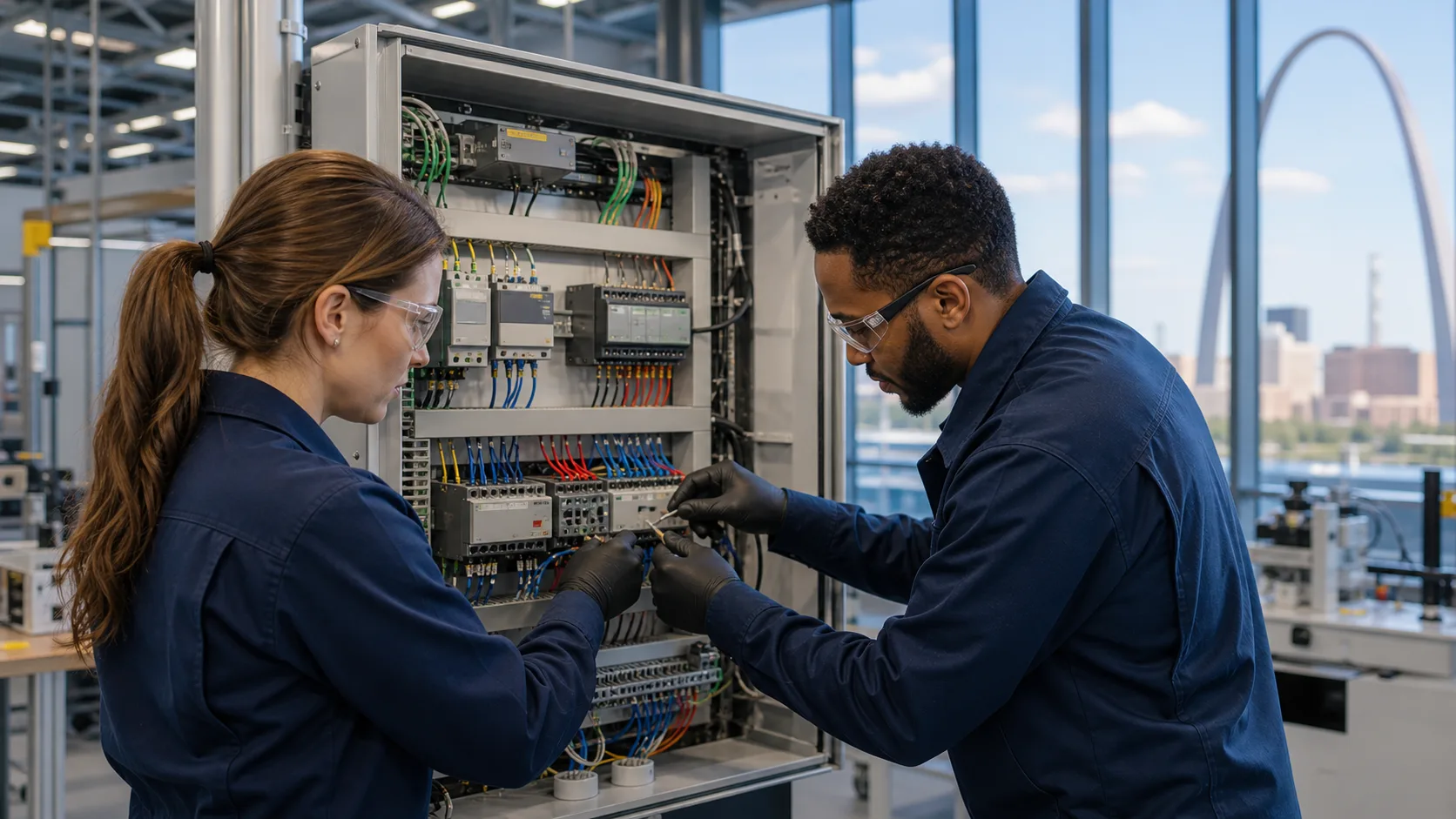
Engineered custom control panels enable facilities to increase the performance of existing motors, hoists, and process equipment without full system replacement. By designing controls around the installed base, plants can increase throughput, reduce unplanned downtime, and enhance functional safety. The emphasis shifts from asset replacement to optimized control and data-driven maintenance.
Across heavy industrial environments in the St. Louis region, an engineering-led approach to controls, supported by 24/7 service and predictive maintenance, allows plants to maintain stable production through peak demand instead of reacting to frequent, unplanned disruptions.
Why St. Louis Facilities Require Custom Control Panels
Many industrial sites in and around St. Louis operate in facilities that have undergone multiple generations of equipment upgrades. It is common to find:
- Legacy motors and hoists that remain mechanically sound but rely on outdated control strategies
- A heterogeneous mix of OEM platforms sourced over many projects and contractors
- Control panels that have been incrementally expanded with limited standardization
Under these conditions, standard off-the-shelf control panels rarely align with the specific process requirements or installed base. Custom control panels provide a structured, reliable control architecture for equipment that was never originally designed to interoperate.
A properly engineered custom panel can support complex industrial applications, including:
- Multi-axis hoisting for steel, coils, or large assemblies
- Coordinated conveyor systems that must start, stop, and transfer in defined sequences
- Critical material handling for batch, continuous, or high-speed packaging operations
Panels also need to be designed in accordance with each plant’s safety and compliance requirements. This can include guarded zones, lockout/tagout provisions, emergency stop device placement, and clear segregation of power and control circuits. When these elements are integrated into the panel design, operators experience fewer nuisance trips and can maintain higher levels of productive runtime.
From a business and operations perspective, custom control panels support:
- Higher OEE by reducing minor, repetitive stoppages
- Faster changeovers between product families or seasonal production profiles
- More efficient utilization of maintenance and production labor across shifts
Instead of waiting for failures and responding reactively, facilities can plan panel upgrades that are directly aligned with capacity, reliability, and safety objectives.
Engineering Control Panels for Harsh Industrial Duty
Industrial automation in St. Louis frequently operates in demanding environments. Metal fabrication, chemical processing, food and beverage, and heavy manufacturing each impose distinct electrical and mechanical requirements on control hardware. Robust panel engineering begins with understanding these conditions and designing accordingly.
Key electrical design considerations include:
- Component selection sized for high-inrush motor loads and frequent starting duty cycles
- Short-circuit current ratings matched to available fault current from plant power distribution systems
- Proper grounding, bonding, and shielding to limit EMI/RFI that can cause nuisance trips or erratic behavior
Mechanically, panels must withstand heat, dust, moisture, vibration, and, where applicable, washdown. Typical design measures include:
- Selecting enclosure ratings and materials based on the actual location classification (NEMA types, corrosion resistance, and food-grade requirements)
- Planning internal layouts so heat-generating components have adequate airflow and spacing
- Implementing thermal management, such as fans, filters, heat exchangers, or air-conditioning units, where internal temperatures could otherwise reduce component life
Integration is a further critical factor. Modern panels must interface reliably with VFDs, soft starters, hoist controls, and other power electronics, often within the same enclosure. Clear segregation of power and control wiring, defined line/load routing, and structured terminal layouts help mitigate noise issues and simplify commissioning and future modifications.
Documentation and physical organization are as important as component selection. When drawings accurately reflect the as-built panel, identification labels are durable and legible, and wire numbers are consistent and visible, technicians can:
- Troubleshoot more rapidly during breakdown events
- Execute lockout/tagout procedures with greater confidence
- Support subsequent modernization, expansion, or control strategy changes with reduced risk
Engineering for maintainability yields measurable time savings every time the enclosure is accessed.
Integrating Automation, Functional Safety, and Predictive Analytics
A custom control panel functions as a central element of the automation architecture. It aggregates field device signals, executes PLC logic, and coordinates operator commands with safety systems and higher-level supervisory control.
Well-designed panels support:
- PLC and HMI platforms that provide operators with actionable feedback and intuitive control interfaces
- Connection points for SCADA or plant-wide systems that supervise multiple lines or entire facilities
- Standardized I/O structures to facilitate replication of proven designs across multiple areas or plants
Functional safety needs to be integrated into the design from the outset. Safety circuits, interlocks, and hoist or motion controls must align with NFPA 70E electrical safety practices, OSHA requirements, and applicable ANSI/ASME standards for hoisting and material handling. This often involves:
- Dedicated safety relays or safety PLC functions
- Appropriately rated emergency stop devices and guard interlock switches
- Clear electrical and physical segregation of safety-related control circuits from standard control circuits
As facilities pursue higher uptime and reliability, predictive maintenance capabilities become increasingly important. By incorporating sensing, data logging, and connectivity at the panel level, plants can track, for example:
- Motor temperatures, vibration profiles, and start/stop patterns
- Hoist cycles, loads, and indicators of brake wear or performance drift
- Power quality parameters that may affect equipment life and system stability
Integrated into maintenance planning and CMMS workflows, this data supports condition-based and predictive maintenance strategies, enabling work to be scheduled before failures occur, rather than during peak production windows when downtime is most costly.
From Repair and Retrofit to Full Modernization
When a control panel fails or exhibits declining reliability, many facilities default to like-for-like repair. While this restores short-term operation, it also perpetuates legacy issues. A more strategic approach is to pursue engineered retrofits that modernize controls while retaining motors, hoists, cabling, and power distribution equipment that remain serviceable.
Effective strategies in heavy industrial environments include:
- Replacing relay logic with PLC-based controls while preserving suitable field devices
- Integrating VFDs or soft starters on existing motors to improve control, reduce mechanical stress, and lower energy consumption
- Standardizing panel layouts, components, and design conventions across multiple lines to simplify spare-parts stocking, training, and troubleshooting
Phased modernization allows plants to balance production requirements with long-term reliability and safety goals. Many facilities:
- Prioritize high-risk assets or assets with the greatest contribution to unplanned downtime
- Schedule work during weekends, nights, or planned outages to minimize disruption
- Utilize surplus and remanufactured components where appropriate to keep legacy systems operational while new designs are deployed
Partnering with a service provider that offers 24/7 support, on-site troubleshooting, and in-house remanufacturing capabilities can reduce project timelines and risk, particularly during colder seasons and year-end maintenance windows when many plants plan their most disruptive control upgrades.
Partnering with a Local Control and Motor Specialist
For industrial automation in St. Louis, collaboration with a local engineering and service organization offers distinct advantages. A team familiar with regional industrial sectors, utility power characteristics, and common plant constraints can design and implement control panels that reflect actual operating conditions rather than generic catalog specifications.
Zeller Technologies focuses on aligning custom control panels with motors, hoists, and predictive maintenance strategies to support safe, reliable, and scalable operation. The objective is to enable plant engineers, maintenance managers, and operations leaders to transform aging and mixed equipment into coordinated systems that are easier to operate, more maintainable, and better prepared for future production demands.
Get Started With Your Project Today
If you are ready to modernize your facility, our experts in industrial automation in St. Louis can help you move from concept to implementation with confidence. At Zeller Technologies, we work closely with your team to design practical, scalable solutions that fit your operations and budget. Tell us about your goals, challenges, and timelines, and we will outline clear next steps. Reach out today through our contact page to start your project.