
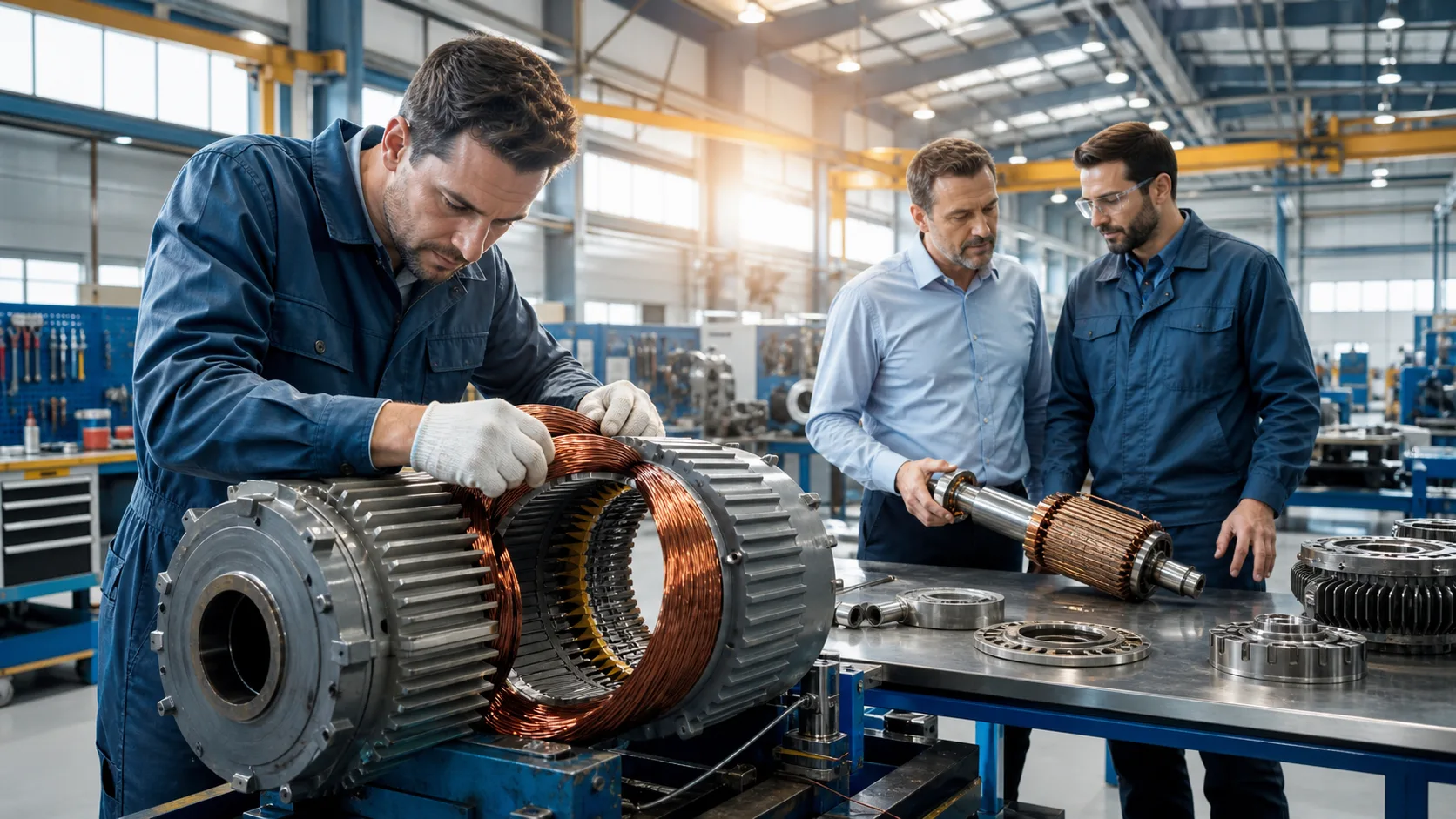
Motor rewinding services are one of the biggest levers heavy industry has for controlling long-term motor costs. When a critical motor fails, the decision to rewind or replace has direct impact on downtime, reliability, and energy use for years. The choice is rarely simple, especially as plants prepare for winter peak demand and planned maintenance outages.
In this article, we will walk through what really drives the cost of a rewind, the hidden financial impacts around the work, and how a structured, data-driven approach can guide your decision. Our goal is to help maintenance, reliability, and operations teams see motor rewinding as part of a broader reliability and cost strategy, not just a repair line item.
Balancing Cost and Reliability in Motor Rewinding
In heavy industry, motors are not just spare parts; they are production capacity. When a large hoist motor, mill drive, or process pump fails without warning, the direct repair quote is often the smallest part of the financial story. Unplanned failures can trigger:
- Lost production and missed orders
- Overtime for maintenance and operations crews
- Emergency freight and rushed logistics
- Safety and quality risks during rushed restarts
That is why motor rewinding services should be viewed as a strategic decision. The real question is not only, “What does the rewind cost?” but, “What is the best total cost of ownership over the next several years?” Sometimes that means rewinding, and sometimes it means replacing or modernizing.
Using data from inspection, testing, and performance history lets you weigh options before you commit. A structured review of failure mode, motor criticality, and long-term plant plans gives you a clearer answer on which path will deliver the lowest total spend.
Direct Cost Drivers in Motor Rewinding Services
The invoice for a rewind is shaped by a series of technical steps. Each step adds labor, materials, or risk that must be managed carefully:
- Disassembly and inspection
- Core testing and cleaning
- Removal of old windings
- Rewind labor and winding configuration
- Insulation materials and copper conductors
- Machining, shaft or journal work if needed
- Reassembly, runout checks, and balancing
- Final electrical and functional testing
How complex (and costly) these steps become depends heavily on the motor’s design and application. Certain designs introduce more rigging, tighter tolerances, and more demanding electrical requirements, which directly increases labor hours and the level of testing required.
Motor design features drive how complex these steps become. For example:
- Large mill drives often involve heavy rigging, complex cooling passages, and higher copper content.
- High-voltage motors add more demanding insulation systems and higher testing requirements.
- Hoist and crane motors may have special braking or control interfaces that add to teardown and reassembly time.
- Harsh-duty or hazardous-location enclosures need extra care to maintain ratings.
Operating duty cycle also matters. Motors that run continuously at high load typically need closer attention to thermal limits, insulation class, and winding configuration to ensure the rewind performs reliably once the unit returns to service.
There are market influences as well. Copper prices, material lead times, and year-end maintenance backlogs can all affect when work can be completed and how service providers plan labor and inventory. Plants that plan rewinds ahead of busy seasons have more flexibility to avoid rush conditions.
Hidden Financial Impacts Beyond the Rewind Invoice
The true cost of a motor failure almost always goes beyond the repair scope. Indirect costs can quietly exceed the price of the rewind itself:
- Downtime, lost margin, and delayed shipments
- Overtime and weekend work for repair and restart
- Temporary workarounds like rental motors or drives
- Expedited freight for parts or replacement units
Energy performance is another key factor. For large, continuous-duty motors, even a small change in efficiency shifts operating cost over time. A well-executed rewind that preserves or improves magnetic performance can support strong efficiency, while poor practice, like overheating the core or careless slot preparation, can increase losses. For older, lower-efficiency units that run constantly, a replacement with a more efficient motor may be the better long-term choice.
There is also risk in substandard rewinds. Incomplete cleaning, poor insulation systems, or rushed workmanship can create reliability and performance issues that show up months later, not immediately at startup. These problems can:
- Shorten insulation life
- Increase operating temperatures
- Create partial discharge or tracking problems
- Lead to repeat failures and more unplanned downtime
What looks like a low-cost rewind can turn into a cycle of repeated outages, emergency work, and lower confidence in your installed base.
Rewind Versus Replace: Building a Cost-Justified Framework
A disciplined framework helps remove guesswork from the rewind versus replace decision. Instead of relying on a single repair quote, teams can make a defensible choice based on risk, lead times, and the expected service life of the asset. Key factors include:
- Motor criticality to safety, production, and quality
- Age and historical failure modes
- Availability and lead time of OEM or equivalent replacements
- Fit with plant modernization or controls upgrades
- Expected remaining mechanical life of the frame, rotor, and core
Lifecycle cost comparison should account for more than the purchase price. It should include the full set of costs and risks you absorb during removal, installation, and the first operating cycles back in production:
- Rewind or replacement acquisition cost
- Installation, alignment, and commissioning work
- Startup and integration risk, especially with drives and controls
- Expected efficiency and energy use
- Predicted maintenance and inspection intervals
An engineering-focused partner can support this framework using root-cause failure analysis, insulation and core testing, and reliability modeling. By understanding whether a failure was due to contamination, overload, power quality, bearings, or installation, you can decide if a rewind with specific upgrades will solve the problem or if a new design is better aligned with long-term reliability goals.
Leveraging Predictive Maintenance to Reduce Rewind Spend
The best way to control rewind spending is to avoid catastrophic failures in the first place. Predictive tools help you intervene before windings and cores are badly damaged:
- Vibration analysis to detect mechanical and electrical imbalance
- Motor current signature analysis for rotor and load issues
- Insulation resistance and polarization index testing for insulation health
- Thermography to spot hot spots and cooling problems
- Online monitoring for critical motors to track trends over time
When you catch issues early, you can take action in a planned and lower-risk way. This typically reduces both the scope of repair work and the “rush” costs that come with emergency breakdowns. Early intervention helps you:
- Schedule rewinds for planned outages instead of emergency windows
- Limit collateral damage to shafts, bearings, and cores
- Avoid premium emergency service and freight conditions
- Keep spares strategies aligned with real risk profiles
A strong reliability program ties motor rewinding services into a larger plan that includes clear quality expectations, defined spares coverage, and condition-based decision triggers. In practice, this includes:
- Standardized repair specifications and quality checks
- Defined critical spares and swap strategies
- Condition-based maintenance triggers based on real data
This smooths your maintenance budget over time and reduces the surprise costs that come with unplanned failures.
Partnering with Zeller Technologies for Lower Lifecycle Cost
At Zeller Technologies, we focus on combining motor, hoist, control, and predictive maintenance expertise to reduce lifecycle cost for manufacturers and heavy industry. Our teams provide engineering support, 24/7 emergency response, and structured repair standards to help plants shorten downtime and increase reliability for each rewind decision.
Because we also work in modernization, remanufacturing, and controls, we view a planned rewind as an opportunity to improve performance, safety, and energy use, not just restore operation. By aligning motor rewinding services with long-term reliability strategies, we help maintenance and operations teams turn reactive failures into planned, cost-justified investments that support production through peak demand seasons and beyond.
Protect Your Motors And Prevent Costly Downtime
If you are seeing performance issues, overheating, or unexplained trips, our motor rewinding services can help restore reliability and extend equipment life. At Zeller Technologies, we assess your application, recommend the most practical repair or replacement path, and complete work to exacting standards. Reach out today and let us review your equipment, timelines, and goals so you can plan confidently. If you are ready to talk specifics or request a quote, simply contact us.